Showing posts with label Stick and Elastic Book. Show all posts

Tuesday, September 29, 2015

Book Arts Tuesday-Book Play to Celebrate Autumn


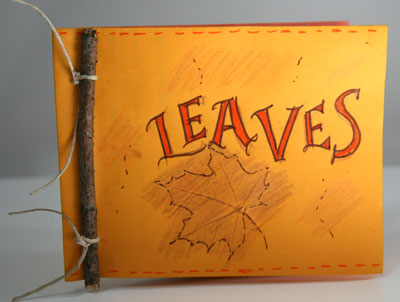
I just made the flyer for my upcoming Book Play workshop at the Newburyport Public Library for adults at the Newburyport Public Library. I love autumn. It will be such fun to make books to celebrate the season. These are the stick and elastic books but tied with jute and string instead of using an elastic. I'll bring sticks and leaves for rubbing but am also encouraging participants to gather and bring their own. As is the case with all Book Play workshops, I'll guide everyone throught the construction step-by-step and then there will be time to play with leaf rubbings, collage paper, and quotes. I look forward to sharing some of the books at the end of the month.


Sunday, October 27, 2013

Studio Sunday-A Most Beautiful Thank You

A most beautiful thank you from a class of graduate education students has a place of honor on my desk. The student who designed this was especially inspired by the environmental message of using recycled materials. It's aways gratifying to work with a group that you know will put what they have learned to immediate use in their classsrooms. Thank you to Emma and her fellow teachers.

Tuesday, July 30, 2013

Book Arts Tuesday-Bookmaking in Argentina

Rafaela Zurbriggen sent me these photos from her class at the IPEM 190 Carande Carro secondary school in Cordoba, Argentina. She was taught bookmaking by Alex Appella who also shared information from makingbooks.com. The students used mostly recycled materials and wrote about their lives for their English class. Here's what they said:

"Making our own books was a really exciting and an unforgettable experience. Besides English is a really difficult subject for us and we are not accustomed to write anything in English. But with this experience of writing about our identities and making our life books we felt that we were able. "


Directions for the Stick and Elastic Book

I love to share work from around the world. Feel free to send me photos from your class or family bookmaking adventures. susan (at) susangaylord.com

Tuesday, March 12, 2013

Book Arts Tuesday-A Book for Almost Spring

It's almost-spring. The days are longer, the sun is stronger but there's still snow on the ground here and I am itching for flowers and green. Here's a little book to tide us through—a stick and elastic book made with a sprig of plastic flowers, 2 sheets of used copy paper folded in half the long way with the writing on the inside and then in half again. I collected a few garden quotes and did the writing with colored pencil.


Thursday, April 21, 2011

National Poetry Month/Haiku Stick & Elastic Book


This simple book form is perfect for haiku. I chose to use poems by haiku master Issa rather than write my own. My book was made from recycled paper with writing on one side only, a stick, and an elastic from vegetables. The illustrations are a combination of drawing and collage. I used glue for the letters on the cover but didn't need it on the inside because the illustrations were made from adhesive backed designs left over from postage stamps and drawing.

Written Directions

In Spanish

Video

See all the pages on flickr

Saturday, April 09, 2011

National Poetry Month/Sijo

Here is a sijo poem (often described as the Korean haiku), by Linda Sue Park from her book, Tap Dancing on the Floor. I love what is says about poetry. I'm trying to take some time to write out poems I like during poetry month. And to keep it easy and loose and not a big deal. So I grabbed the closest blank surface (the back side of an envelope) and a marker (Y & C Calligraphy 2.0) and wrote. I took a deep breath, decided not to let it bother me that there should have been more space between the second and third stanzas and that there are two dots over one of the i's, and took this photo to share it.

Here's a link to a previous post with information on writing sijo, a simple book project, and more information about Linda Sue Park's book.

Monday, April 04, 2011

National Poetry Month/Getting Started

April is National Poetry Month in the US. I'll be making a poetry related post each day. Celebrate the month by reading poems, writing your own, making books, and rejoicing in the wonderful gift that is poetry.

Feel free to copy and share the above image (credit is always appreciated). It's also available as a pdf.

For today, there is a link to a past post—a Sticker Poem made with recycled materials and an annotated list of poetry anthologies for children.

Monday, March 07, 2011

Butterfly Stick and Elastic Book

Here's a great book to get ready for spring. Vicki Bilton from the UK made this butterfly book with her students. She used a flexible straw instead of a stick and used the bendy end to attach a head and antennae. Delightful!

Stick and elastic written directions (English and Spanish)

Video directions

Monday, February 15, 2010

Winter Buds Sketchbook


Winter is a great time to look at the trees and shrubs around us. We get a clear view of their shape and structure and a reminder that warmer weather is on the way when we look at the buds that will brings leaves and blossoms in the spring. Late in the summer after I graduated from high school, my grandfather and I were walking around his garden. I asked him what flower would be blooming so late in the season from the buds on one of his shrubs. He told me that they were the buds for the flowers for next spring. I was shocked both at the concept and the fact that I had gone through twelve years of school and didn't know such an obvious fact about the world around me. It is a reminder that we have much to learn from observing the world around us and from our elders.

I made my book with reused US Letter/A4 paper folded in half the long way with the writing on the inside, a horse chestnut twig, and an elastic. I snipped the twigs and did my drawings at home but you could also do your sketching outdoors.

Written directions

Video

My Winter Buds Book on flickr

Monday, July 13, 2009

Sijo Stick and Elastic Book


Stick and Elastic Book written directions (web and pdf)


Stick and Elastic Book youtube tutorial


Sijo (shee-jo) is a Korean form of poetry, sometimes called the Korean haiku. The Boston Globe published an article about Harvard's Korea Foundation professor of Korean literature David McCann (who I had the privilege of meeting before my trip to Korea) and his quest to introduce the rest of us to sijo. This month's project is a stick and elastic book to make a home for your sijo poems.

Sijo have 3 lines, each with 14-16 syllables. The first line of the poem introduces the subject, the second line develops it, and the third offers a twist. Because the lines are rather long, they are sometimes written out in six lines. I've taken the liberty of sharing one of the poems from Linda Sue Park's Tap Dancing on The Floor which was featured in an interview on childrenslit.com:

WISH

For someone to read a poem
again, and again, and then,

having lifted it from page
to brain-the easy part-

cradle it on the long trek
from brain all the way to heart

Book 1: The long, narrow shape of the top book lends itself to the three line version. I used 4 pieces of used copy paper with writing on one side folded in half with the writing on the inside for the pages. Instead of an elastic, I used 2 strips cut from a piece of plastic netting on a clementine box and tied them together with a double knot at the top and bottom.

Book 2: This book would be best for the six line variation. I punched the holes along the fold rather than on the pages. The stick is less decorative but the pages will open flat. I used all recycled materials: a plastic piece from a ball point pen for the stick, an elastic from vegetables, used wrapping paper, and used copy paper attached with fruit stickers instead of glue.

BOOKS AND LINKS

Tap Dancing on the Roof: Sijo (Poems)
Linda Sue Park, whose book A Single Shard won the Newbery Medal in 2002, has written a wonderful book of sijo poems for children with an author's note about the history and tips for writing sijo of your own.


School Library Journal Interview with Linda Sue Park


childrenslit.com Interview with Linda Sue Park


Boston Globe Article about David McCann
Listen to him explain, recite, and sing sijo on page 2.

Wednesday, October 15, 2008

Sticker Poem Book


http://www.makingbooks.com/elastic.shtml

This book is a variation on the stick and elastic book. Because the plastic piece from the socks has a place for the elastic, I was able to wrap the elastic in the curves and run it along the inside of the folded pages.

As I made sample books for the Homes for Poems workshop at the Massachusetts Poetry Festival in Lowell, I had fun playing with recycled materials. This book used the side panels from a grocery bag for the pages, a plastic piece that came with a purchase of a pair of socks and an elastic for the binding, and candy wrappers, fruit stickers, and the left over sticky paper from red and green dot stickers that were left over from jurying at the Newburyport Art Association to decorate the pages. The poem was inspired by the fruits the stickers were on. You can view the entire book here.

As I was preparing for the workshop, I spent some time selecting a collection of poetry anthologies for children. You might not always want to write an original poem for your book; sometimes it's fun to use one of your favorite poems. Here is an annotated list in no particular order.

A Family of Poems: My Favorite Poetry for Children
Caroline Kennedy, paintings by Jom J Muth. New York: Hyperion Books for Children, 2005.
I like the collection of poems and Caroline Kennedy's reminiscences about reading and reciting poetry aloud with her family.

Around the World in Eighty Poems
Selected by James Berry, illustrated by Katherine Lucas, San Francisco: Chronicle Books, 2002.
Poems from more than fifty countries include traditional poems and songs and ones by contemporary poets. A nice introduction by James Berry closes with "Perhaps the poems in this anthology will build bridges for you. This collection offers you fresh poems as new acquaintances, which I hope will become new friends."

Talking Like the Rain: A Read-to-Me Book of Poems
Selected by X.J. Kennedy and Dorothy M. Kennedy, illustrated by Jane Dyer. Boston: Little, Brown and Company, 1992.
This delightful collection of poems for children is organized in the following sections: Play; Families; Just for Fun; Birds, Bugs, and Beasts; Rhymes and Songs; Magic and Wonder; Wind and Weather; Calendars and Clocks; Day and Night. The poems are great for reading aloud.

The Random House Book of Poetry for Children
selected by Jack Prelutsky, illustrated by Arnold Lobel. New York: Random House, 1983.
This was the poetry anthology we had in our library when my kids were young. There are lots of great poems organized in sections like The Four Seasons, Dogs and Cats and Bears and Bats, I'm Hungry!, and Alphabet Stew.

A Jar of Tiny Stars: Poems by Ncte Award-Winning Poets
edited by Bernice E. Cullinan, illustrated by Andi MacLeod. Honesdale, PA: Wordsong, Boyds Mill Press, 1996.
Poems by David McCord, Aileen Fisher. Karla Kuskin, Myra Livingston Cohen, Eve Merriam, John Ciardi, Lilian Moore, Arnold Adoff, Valerie Worth, and Barbara Esbensen are accompanied by a portrait of the poets, their writing about writing poetry, and a short biography.

This Place I Know: Poems of Comfort
selected by Georgia Heard, illustrated by eighteen renowned picture book artists including William Steig and Melissa Sweet. Cambridge, MA: Candlewick Press, 2002.
Georgia Heard was asked by a friend who is superintendent of District 2 schools in Manhattan to gather poems of comfort for New York schoolchildren who had witnesses the World Trade Center tragedy. These poems can bring comfort to all children, and adults, in whatever trying times they find in their own lives.

Hey, You!: Poems to Skyscrapers, Mosquitoes, and Other Fun Things
selected by Paul Janeczko, illustrated by Robery Rayevsky. New York: HarperCollins Publishers, 2007.
A selections of poems from humorous to serious written to things: sneakers, mosquitos, snowflake, buffalo, hat hair, the Vietnam Memorial. In the preface, the editor suggests writing your own poems to things and these are great inspirations to get started.

Talking to the Sun: An Illustrated Anthology of Poems for Young Peopleselected and introduced by Kenneth Koch and Kate Farrell. New York: Metropolitan Museum of Art, Holt, Rinehart and Winston, 1985.
A wide-ranging selection of poems ranging across time and place are illustrated with works from the Metropolitan Museum of Art. A feast of words and images.

Sing A Song Of Popcorn: Every Child's Book Of Poems
selected by Beatrice Schenk de Regniers, Eva Moore, Mary Michaels White, and Jan Carr, illustrated by Marcia Brown, Leo and Diane Dillon, Richard Egielski, Trina Schart Hyman, Arnold Lobel, Maurice Sendak, Marc Simont, and Margot Zemach. New York: Scholastic, Inc., 1988.
The well-chosen poems are grouped by theme and illustrator: themes and illstrators include Fun with Rhymes illusterated by Trina Schart Hyman, Mostly Weather illustrated by MArcia Brown, Mostly Animals by Arnold Lobel.

The Kingfisher Book of Family Poems (Kingfisher Book Of)
selected by Belinda Hollyer, illustrated by Holly Swain. New York: Kingfisher, 2003.
The family poems in this volume are broad in scope. They go from humorous to sad and include all kinds of families. A poem called I wish I was (an only child) is followed by I have none.

Heart to Heart : New Poems Inspired by Twentieth-Century American Art
edited by Jan Greenberg. New York: Harry N. Abrams, Inc. Publishers, 2001.
American poets were invited to choose a work of twentieth -century American art and write a poem inspired by it. The results were organized into four categories: Stories (poems about the art that tell an aanecdote or conjure a memory), Voices (poet steps inside the painting and assumes the voice of the person or object), Impressions (poets paint word pictures of the work of art), Expressions (poets explore aspects of visual form that concern the nature of art and the artist). The book is wonderful to look at and view and also can make a starting point for a collaboration between art and language arts teachers or for a visit to the museum.

Tuesday, October 09, 2007

Book of Leaves

leaves1
leaves2

http://www.makingbooks.com/elastic.shtml

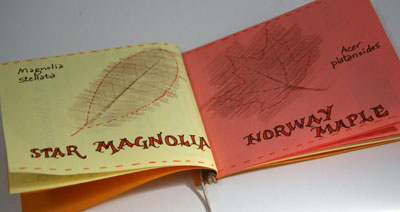
Fall is a time when we pay special attention to leaves in New England. This month's project is a Book of Leaves with leaf rubbings on each page. I tried the rubbings with both crayon and colored pencil and preferred the colored pencil, but you might decide otherwise. You could also attach the actual leaves or make leaf prints with paint.

You will need two or more pieces of paper, a stick, and an elastic or 2 pieces of cord or yarn. In keeping with my current focus on using recycled materials whenever possible, I used three pieces of paper that had writing on one side only (flyers that I was given at a conference).

1. Fold each paper in half the long way so that is long and skinny like a hot dog. If it has writing on it, the writing should be on the inside.

2. Fold each paper in half the other way.

3. Tuck the folded pages inside each other.

4. Punch two holes a little way in from the folded edge, one toward the top and one toward the bottom. I find that I am only able to punch through all the layers at once if I use 2 sheets of paper. If you use more, you may have to punch the holes in one or two sheets and then use that as a guide to mark the placement of holes for the rest of the paper.

5. Make the leaf rubbings on the pages. I think it is easier to make the leaf rubbings before you bind the book with the stick because the pages lay flatter. I punch the holes first to serve as a visual guide. If your rubbing is too close to the fold, part of it will be hidden under the binding.

6. Follow the directions to bind the book together. Because I wanted a more earthy look to my book than an elastic would provide, I used two pieces of hemp cord. I tied the two pieces together toward the end. I inserted the two ends in the top hole, pulled both pieces of cord along the back of the book and up into the bottom hole. I pulled the cord tightly and tied the two ends together in the front at the bottom hole.

Links

Why Leaves Change Color
A simple explanation written for children can be found at
http://www.sciencemadesimple.com/leaves.html

and a more detailed explanation at
http://www.na.fs.fed.us/spfo/pubs/misc/autumn/autumn_colors.htm

Big Dipper and the Colors of Autumn
Retelling of Algonquin legend which explains why leaves change their color in the fall
http://starryskies.com/articles/dln/9-97/dipper.colours.html

Tree Identification
Have a leaf with you and click on the leaf key at the bottom of the page. It will lead through a process to identify your leaf.
http://www.fw.vt.edu/dendro/forsite/Idtree.htm

No Child Left Inside
Leave No Child Inside, an article by Richard Louv in the March/April 2007 issue of Orion magazine
http://www.orionmagazine.org/index.php/articles/article/240

Richard Louv's website
http://thefuturesedge.com

Last Child in the Woods has had great impact. Giving No Child Left Behind a twist, there is a movement that grew out of the book called No Child Left Inside. I couldn't find a central website but searching No Child Left Inside will bring up many sites and blogs.


Adapted from the October 2007 issue of Making Books Monthly
Free subscriptions available at makingbooks.com.

Monday, January 08, 2007

Chinese New Year Journal

The Chinese year 4075, the Year of the Pig, starts on February 18. To get an early start on preparing for the celebration, this month's featured project is A Chinese New Year Journal and the links lead to sites with information about Chinese writing and calligraphy.


Chinese New Year Journal


Cover

http://www.makingbooks.com/elastic.shtml

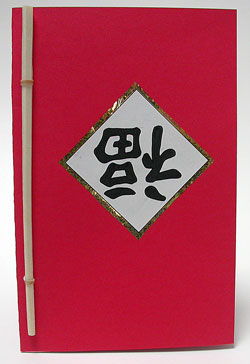
The Chinese New Year Journal is one of the five projects in my ebook, Gung Hay Fat Choy: Making Books for Chinese New Year. Use a chop stick for the stick. Red is a lucky color in China and a good choice for the cover. The characters on the front are fu, the word for luck in Chinese. At New Year, the word is hung on the door upside down to say that luck has arrived.

You can print out a Fu pattern to glue on the cover.

Links

Chinese Calligraphy
This is a good basic introduction which would be accessible to kids.
http://library.thinkquest.org/3614/drawing.htm

More Information
For a deeper look at writing Chinese characters, take a look here.
http://www.chinese-outpost.com/language/characters/default.asp

Appreciation of the Art of Chinese Calligraphy
A selection of single words written by masters of Chinese calligraphy illustrate a variety of styles. The idea here is not to learn how to write with a brush, or what the words are, but just to look at them as an abstract art. If you follow the arrow at the end of the page, you'll get to more information about Chinese calligraphy including the work of masters, essays, and links.
http://www.chinapage.com/calligraphy.html

Calligraphy Signs in the Hong Kong Subway Station
These signs from the Hong Kong subway are beautiful to behold.
http://www.chinapage.com/calligraphy/sign/hongkong/subway.html

Your name in Chinese
Enter your name, birth date, desired essence of the name, and gender and get your name in Chinese.
http://www.mandarintools.com/chinesename.html


Adapted from the January 2007 issue of Making Books Monthly
Free subscriptions available at makingbooks.com
Related Posts Plugin for WordPress, Blogger...

ShareThis