Showing posts with label Women in the Arts. Show all posts

Monday, March 08, 2021

Abigail May Alcott on International Women's Day


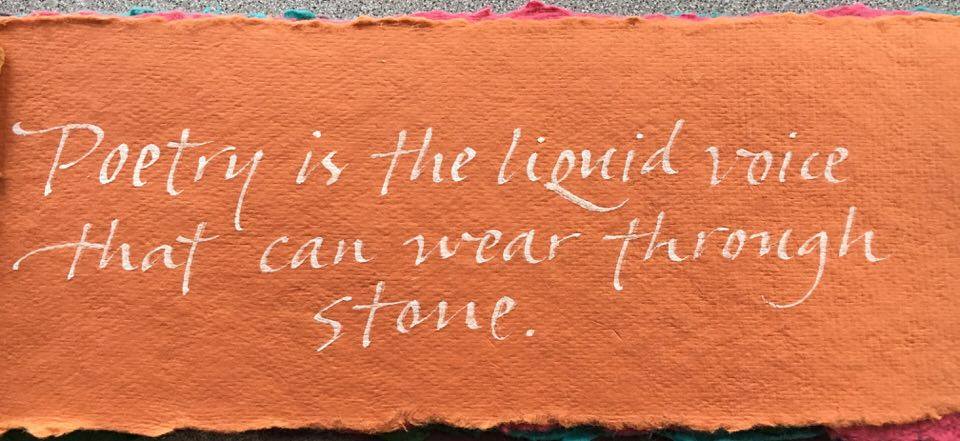
Abigail May Alcott often said these words to her daughter Louisa who let the world know she was alive through her writing, especially the beloved Little Women. From the book My Heart is Boundless: Writings of Abigail May Alcott, Louisa's Mother edited by Eve LaPlante who is a cousin of Louisa May Alcott and a great-niece of Abigail May Alcott. 

Thursday, August 08, 2019

Words from Susan

I have added a new feature on my website: Words from Susan. It grew out of my love for writing out quotes and my feeling of helplessness at the state of the world. I do believe in the power of words—to inspire, to comfort, and to heal. You can view the quotes and download them as printable pdfs. Feel free to share widely, with credit, but no commercial use, please. The most recent quote (pdf here) is from Toni Morrison, in honor of her work and her life. To find out when new quotes are posted, subscribe to the blog and/or follow me on facebook or instagram.

Friday, December 14, 2018

Forty Years #27: Childbirth Journey in Black and White

My first stop on the way to making books was a portfolio of 8.5" x 11" offset prints of Childbirth Journey. They combined charcoal drawings, calligraphy, and bits of photocopied natural objects—milkweed in #3 core of contentment and asparagus in #4 unstoppable life force.


Thursday, November 09, 2017

Anne Truitt Quote


Here's a midweek post as I missed Studio Sunday. This is an adaptation of a quote from Daybook by Ann Truitt. An old post about her series of published journals contains the complete passage.

The lettering was done with a brush and the artgraf graphite block I've used for the last couple of posts.

Tuesday, April 25, 2017

Poetry Month-Quote from Adrienne Rich


Here's a quote from Adrienne Rich for Poetry Month. It is one of the pages in a fan book called Women's Words that I made for a friend's birthday. I used Shizen paper from Artist & Craftsman and Dr. Matin's bleedproof white with a Speedball nib. I love fan books—easy to make and dramatic in presentation. You can find directions at The Joy of Making Books on my youtube channel.


Friday, January 20, 2017

Left-Handed Commencement Address by Ursula Le Guin


This lasting sharing before tomorrow's Women's March is a 1983 commencement address that Ursula K. Le Guin gave at Mills College. These profound words are just as, if not more, meaningful today. Ursula Le Guin shares it on her website with permission for reprinting. My son introduced me to this and has made a little hot dog book of the text. Feel free to print and share. Directions for making the hot dog book are on my Joy of Making Books youtube channel.

I want to thank the Mills College Class of ’83 for offering me a rare chance: to speak aloud in public in the language of women.

I know there are men graduating, and I don’t mean to exclude them, far from it. There is a Greek tragedy where the Greek says to the foreigner, “If you don’t understand Greek, please signify by nodding.” Anyhow, commencements are usually operated under the unspoken agreement that everybody graduating is either male or ought to be. That’s why we are all wearing these twelfth-century dresses that look so great on men and make women look either like a mushroom or a pregnant stork. Intellectual tradition is male. Public speaking is done in the public tongue, the national or tribal language; and the language of our tribe is the men’s language. Of course women learn it. We’re not dumb. If you can tell Margaret Thatcher from Ronald Reagan, or Indira Gandhi from General Somoza, by anything they say, tell me how. This is a man’s world, so it talks a man’s language. The words are all words of power. You’ve come a long way, baby, but no way is long enough. You can’t even get there by selling yourself out: because there is theirs, not yours.

Maybe we’ve had enough words of power and talk about the battle of life. Maybe we need some words of weakness. Instead of saying now that I hope you will all go forth from this ivory tower of college into the Real World and forge a triumphant career or at least help your husband to and keep our country strong and be a success in everything - instead of talking about power, what if I talked like a woman right here in public? It won’t sound right. It’s going to sound terrible. What if I said what I hope for you is first, if — only if — you want kids, I hope you have them. Not hordes of them. A couple, enough. I hope they’re beautiful. I hope you and they have enough to eat, and a place to be warm and clean in, and friends, and work you like doing. Well, is that what you went to college for? Is that all? What about success?

Success is somebody else’s failure. Success is the American Dream we can keep dreaming because most people in most places, including thirty million of ourselves, live wide awake in the terrible reality of poverty. No, I do not wish you success. I don’t even want to talk about it. I want to talk about failure.

Because you are human beings you are going to meet failure. You are going to meet disappointment, injustice, betrayal, and irreparable loss. You will find you’re weak where you thought yourself strong. You’ll work for possessions and then find they possess you. You will find yourself — as I know you already have — in dark places, alone, and afraid.
What I hope for you, for all my sisters and daughters, brothers and sons, is that you will be able to live there, in the dark place. To live in the place that our rationalizing culture of success denies, calling it a place of exile, uninhabitable, foreign.

Well, we’re already foreigners. Women as women are largely excluded from, alien to, the self-declared male norms of this society, where human beings are called Man, the only respectable god is male, the only direction is up. So that’s their country; let’s explore our own. I’m not talking about sex; that’s a whole other universe, where every man and woman is on their own. I’m talking about society, the so-called man’s world of institutionalized competition, aggression, violence, authority, and power. If we want to live as women, some separatism is forced upon us: Mills College is a wise embodiment of that separatism. The war-games world wasn’t made by us or for us; we can’t even breathe the air there without masks. And if you put the mask on you’ll have a hard time getting it off. So how about going on doing things our own way, as to some extent you did here at Mills? Not for men and the male power hierarchy — that’s their game. Not against men, either — that’s still playing by their rules. But with any men who are with us: that’s our game. Why should a free woman with a college education either fight Machoman or serve him? Why should she live her life on his terms?

Machoman is afraid of our terms, which are not all rational, positive, competitive, etc. And so he has taught us to despise and deny them. In our society, women have lived, and have been despised for living, the whole side of life that includes and takes responsibility for helplessness, weakness, and illness, for the irrational and the irreparable, for all that is obscure, passive, uncontrolled, animal, unclean — the valley of the shadow, the deep, the depths of life. All that the Warrior denies and refuses is left to us and the men who share it with us and therefore, like us, can’t play doctor, only nurse, can’t be warriors, only civilians, can’t be chiefs, only indians. Well so that is our country. The night side of our country. If there is a day side to it, high sierras, prairies of bright grass, we only know pioneers’ tales about it, we haven’t got there yet. We’re never going to get there by imitating Machoman. We are only going to get there by going our own way, by living there, by living through the night in our own country.

So what I hope for you is that you live there not as prisoners, ashamed of being women, consenting captives of a psychopathic social system, but as natives. That you will be at home there, keep house there, be your own mistress, with a room of your own. That you will do your work there, whatever you’re good at, art or science or tech or running a company or sweeping under the beds, and when they tell you that it’s second-class work because a woman is doing it, I hope you tell them to go to hell and while they’re going to give you equal pay for equal time. I hope you live without the need to dominate, and without the need to be dominated. I hope you are never victims, but I hope you have no power over other people. And when you fail, and are defeated, and in pain, and in the dark, then I hope you will remember that darkness is your country, where you live, where no wars are fought and no wars are won, but where the future is. Our roots are in the dark; the earth is our country. Why did we look up for blessing — instead of around, and down? What hope we have lies there. Not in the sky full of orbiting spy-eyes and weaponry, but in the earth we have looked down upon. Not from above, but from below. Not in the light that blinds, but in the dark that nourishes, where human beings grow human souls.

Thursday, January 19, 2017

HannyaGrrrl Website


Today's women and arts post is a link to the website of Hanako O'Leary. She is a young artist from Seattle. Her work is sharp and smart and feminist. Take a look.


Here is her artist statement:

The Hannya mask is a mask used in Noh theater, representing a jealous female demon. It possesses two sharp bull-like horns, metallic eyes, and a leering mouth... The Hannya mask portrays the souls of women who have become demons due to obsession or jealousy.  It is said to be demonic and dangerous but also sorrowful and tormented, displaying the complexity of human emotions."
Shielded by an ancient and archetypal smile, Hannyagrrrl explores the tragedy and triumph of modern femininity.

Growing up in a biracial household, I have developed a knack for taking two completely different cultures and synthesizing them into my own aesthetic or philosophy. In doing so, I have come to understand how to tell my story through art. By applying Hannya’s face in a context that reflects my personal experiences as a biracial woman, I use this iconic Japanese image to tell my American story.


Wednesday, January 18, 2017

Lowell Women's Week Book Project


Today's post leading up to the Women's March is about a project I did for Lowell Women's Week in 2012. The theme for the week was All Our Voices. About 250 women and girls made simple books with the prompt of "I am" which were displayed on a clothesline at the Pollard Memorial Library.


You can read about the project here.

You can see images of the books here.

You can learn how to make the basic book here.


Tuesday, January 17, 2017

Women's March Booklet

Here is a little book to commemorate the Women's March on Washington with a quote from Audre Lorde for you to make and share. Print the pdf and cut and fold to make 4 little books to keep or give away.

Cut or tear the paper into fourths.


Fold each piece half like a hamburger so that the quote shows.


Fold the paper in half so the quote is on the inside.


Click here for the pdf.

Feel free to pass this along. I'm looking forward to the march in Boston. I'll be taking the bus organized by the Newburyport YWCA.

Monday, January 16, 2017

Women Rise at 23 Sandy Gallery

On Saturday I will be going to the Women's March for America in Boston. This week I will be posting a women and art related post each day. Today I encourage you to visit the online exhibition Women Rise from 23 Sandy Gallery in Portland, Oregon. Here's how gallery owner Laura Russell describes the collection:

Women Rise is a new curated collection of artist books at 23 Sandy Gallery featuring books that celebrate women and girls, or shed light on important women’s issues. As we start this New Year, women’s issues are first and foremost on a lot of minds. This collection of unique and limited-edition artist books is a special way to tell the stories of women, to celebrate our accomplishments, and to frame a dialog about many important topics. Once again we use books to highlight the power of artists to change the world. 

Also online at 23 Sandy is The Dead Feminists.
Here is the description:

Since beginning their Dead Feminists series of broadsides in 2008, collaborators Chandler O’Leary and Jessica Spring have featured 24 different women from history, connecting their words and stories to current social and political issues. The newest chapter in the series is the publication of Dead Feminists: Historical Heroines in Living Color published by Sasquatch, on sale this fall. This exhibition delves into the process of creating both the prints and the book, from original drawings and ephemera to the latest print in the series to be revealed concurrently with the book release.

Women Rise

The Dead Feminists

Sunday, March 08, 2015

Studio Sunday-International Women's Day


A quote from the files (1983) by Virginia Woolf in celebration of International Women's Day

Tuesday, April 15, 2014

Book Arts Tuesday-Alicia Bailey Interview


A great feature by Zach Wolfson for Beyond the Gallery on Colorado book artist Alicia Bailey on infusion5 web television. She speaks of books, objects, and time. It's beautifully filmed and Alicia's thoughts on making books are eloquently expressed.

Watch the video.

Thursday, December 12, 2013

Blog Giveaway-Brush Booklet


A giveaway for one of the little booklets I have been making from old brush practice papers. This one has a quote from my mentor Jenny Hunter Groat who passed away this year. To be entered in the giveaway, please share a favorite quote. And this is important, you must put your email in the comment so I can send you a message if you are the winner. Entries will close tomorrow, December 13 at midnight.

There are brush booklets in my etsy shop, and I will add more next week.

Tuesday, November 19, 2013

Book Arts Tuesday-Rhonda Ayliffe


Rhonda Ayliffe is an artist from Australia. On her blog she describes herself as "artist, teacher, student, mother, gardener, farmer - that's me in six words." Her entire site is worth exploration—

her art gestures ("every sunday in 2012 I created an 'art gesture'- an ephemeral bit of artiness created during the week captured with an app on my hi-phone"),


her artworks, and


her older calligraphic work.


It was this recent post, honestum circuli - the artists book..., that inspired me to share her work.

honestum circuli - the virtuous circle
is both a semi-permanent physical structure
in the form of a book/herb spiral
surrounded by an emerging dye garden
with citrus trees and associated beneficial plants

AND

an accompanying book consisting of
garden plans and musings,
original drawings, calligraphy and collage,
progress photos and musings on the nature and value of
spirals and gardens and art
(and art as gardening and gardening as art....)


Rhonda Ayliffe's blog and website

Tuesday, October 15, 2013

Book Arts Tuesday-Sarah Wyman Whitman


We've returned from our wonderful three weeks in Paris. I'll be sharing thoughts and images from the trip as I have time to process them. For today's Book Arts Tuesday, I've looked back to the week before we left when my friend Cathy and I went to South Berwick, Maine where we visited the Sarah Orne Jewett House and Hamilton House. We had guided tours of the houses and gardens thanks to a program sponsored by Historic New England and the New England Wildflower Society.

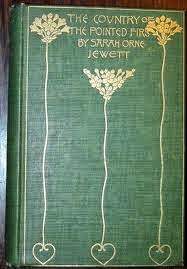
Last summer was my Celia Thaxter summer so it was a pleasure to see the home of her close friend Sarah Orne Jewett and learn more about her. While there, we were introduced to the book covers and bindings of Sarah Wyman Whitman. Bonnie Hurd Smith has written an informative and inspiring post about Sarah on Boston Women's Heritage Trail website. She describes her as "a prolific artist who worked in a variety of media, a patron of the arts, and philanthropist who "influenced almost every aspect of creative life in Boston," according to the art historian Erica E. Hirshler." She began as a painter and studied with William Morris Hunt in Boston and Thomas Couture in France. She had a stained glass studio called the Lily Glassworks and designed windows for Trinity Church in Boston and Memorial Hall at Harvard University.

Sarah Wyman Whitman’s third and most prolific artistic career began in about 1884 when she was asked to design book covers for Houghton Mifflin in Boston. Her clean, linear designs were a marked departure from more elaborate and expensive book covers making her one of the most sought-after book designers in the country. Among the roughly three hundred covers she created were those for her writer friends Sarah Orne Jewett and Celia Thaxter.

Sarah believed passionately in bringing art to everyday life and to everyday objects, which were guiding principals of the Arts and Crafts movement first initiated in England around 1849 and popularized in Boston by the 1870s. In 1895, during a talk for the Boston Art Students Association (founded in 1879 by the first graduating class of the Boston Museum School), she told her audience,

“You have got to think how to apply elements of design to these cheaply sold books; to put the touch of art on this thing that is going to be produced at a level price, which allows for no handwork, the decoration to be cut with a die, the books to out by the thousand and to be sold at a low price.”...

Three years after her death in 1904 at the age of sixty-two, Sarah Wyman Whitman’s friends published a book of her private letters. In the introduction they wrote, “When she went out of this world, it seemed as if the high light had gone from everything.”


To find out more about Sarah Wyman Whitman:

A great collection of photos of her covers and bindings from the Boston Public Library

The Boston Women's Heritage Trail website

The University of Rochester Rare Books and Special Collections

Letters of Sarah Wyman Whitman


Friday, August 30, 2013

Tribute to Jenny in Letter Arts Review

Mike Gold has written a beautiful tribute to Jenny Hunter Groat in the current issue of Letter Arts Review.

At some point, as her work matured in the 1980s, Jenny took her pen and brush beyond words and the limits of calligraphic constructions. It is as if she returned to her roots as a dancer: all that is left on the canvas is the movement and gesture and energy of the brush-made marks. The marks alone told the story she had to tell, just as, earlier in life, her movements as a dancer would tell the story. Merce Cunningham, one of the dancers who inspired Jenny, said of dance, "You have to love dancing to stick to it. It gives you nothing back, no manuscripts to store away, no paintings to show on walls and maybe hang in museums, no poems to be printed and sold, nothing but that single fleeting moment when you feel alive." Jenny had found a way to put dance into manuscripts, paintings, and on the walls of galleries and museums.

Thank you Mike and Happy Birthday Jenny!
Related Posts Plugin for WordPress, Blogger...

ShareThis