I am holding the paperback version of the book, The Story of a Pumpkin, published by the New Hampshire Humanities Council, in my hands and feeling a sense of satisfaction and joy at the completion of a long journey. I post this on the one year anniversary of my first post about the Bhutanese Nepali Folktale Project for which I was the designer. Looking back over the first (and only) two things I wrote and feeling the freshness of the words, I regret that I did not keep writing through the process. Although I relive the stages of its development in my mind as I write, this is very much a retrospective summary.
The Bhutanese Nepali Folktale Project is part of the The New Hampshire Humanities Council statewide literacy initiative called Connections. The project's goals are: to create a bilingual picture book that supports English language acquisition of new Americans from Bhutan, to preserve a traditional tale in the mother tongue, and to present a story for children from all cultures to read. I became involved fairly early in the process, as a story was being selected from the many that were told by members of the community.
The Story of a Pumpkin, as told by Hari Tiwari, was the one chosen. The story had great significance for Hari. As she said in the introduction:
My father used to tell me stories when he combed my long hair. It hurt and the stories made me sit still so I could hear all his words. My mother died when I was very young and he was the one who took care of me. “The Story of a Pumpkin” is one of the stories he told me. It was my favorite story and he told it to me many times.
The more I worked with the story, the more pleased I was with the choice. As the story of a pumpkin who sets out to marry a princess, it is filled with humor. But there is also an evil sister and themes of duty, independence, love, and betrayal.
Writer Terry Farish did a superb job with the literary translation. She started with a straight English translation of the transcription of the recording in Nepali. She spent much time with members of the community to understand all the subtleties of the story and the cultural context. The Story of a Pumpkin reads aloud beautifully and ends with this message:
The teller of this story will receive a flower garland. The listener will receive a golden one. Whoever tells or listens to this story will find a place in heaven.
Unlike the traditional process of publishing where a completed manuscript goes to the designer, the entire project was more a continuum than a series of discrete steps. The words were continually being refined as the illustrations were being gathered. The book was redesigned several times. In the end we had illustrations from many people in the community, adding diversity and variety to the imagery, and the design challenge of integrating them all into a coherent whole.
Chief illustrator Dal Rai created four watercolor paintings that illustrate scenes in the story and evoke the beauty of the landscape of Bhutan. Members of Johanna Young's ESOL class in Concord, NH made small drawings with markers and colored pencil of the flora and fauna of Bhutan. Ram Darjee, also from the class, created additional drawings to illustrate particular objects mentioned in the story.


Here's a bit about the elements in the pages:

The background of every page has texture and color that came from scanning a piece of Resho paper from Bhutan which is what I use in my Spirit Book workshops. I like the warmth it gives to the pages, its cultural connection, and the way it unifies the variety of images and textures on the pages. Its opacity was decreased so that it did not overpower the text and images on the pages.
The FABRIC
One of the first things we did early in the design process was visit Ambika Sharma in Concord, NH and scan fabrics. When I began thinking about the book, I wanted there to be as much cultural resonance as possible. The illustrations represented the visions of particular individuals. I felt that fabrics came from a deeper collective well and spoke more broadly of the traditions of the community.
We used three:


DAL'S PAINTINGS

SPOT ILLUSTRATIONS
In addition to the paintings, there are spot illustrations within circles throughout the book. Several of the circles were filled with details from Dal's paintings and the rest contained illustrations done by Johanna Young's ESOL (English for Speakers of Other Languages) class in Concord, NH.


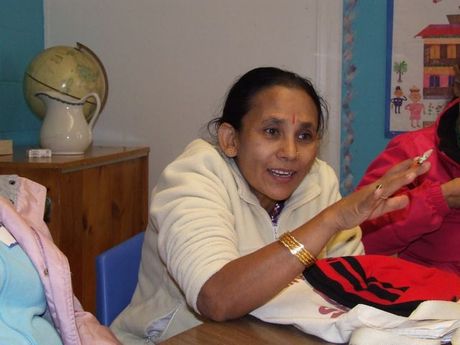
Most of these spot illustrations came from a winter morning Terry, Ambika, and I spent with the class. Ambika read the story in Nepali.

After we did some brainstorming about images from the story, Terry wrote words on a blackboard and on cards.

Then everyone went to work with black markers and colored pencils.

I was amazed at the ease and freedom with which this room full of adults started drawing. They embraced the task with open hearts and created images with great liveliness and charm. We tried to anticipate the images that would best assist the telling of the story and asked for some specific drawings but ultimately decided that the spontaneity with which they were working was the most important thing to preserve.
In addition to the items we had listed on the board, we invited them to draw flowers and plants that they remembered. I love that every flower and plant was complete with roots and thought how different their vision of the plant world is from ours. Their images grew out of their lives in Bhutan where they were lived so closely with the land.

As the book was taking its final shape, Terry and I realized we did need some additional specific spot illustrations and Johanna Young suggested Ram Darjee who had not been in class the day we did the drawings. After meeting with Terry, Ram sent me an envelope with drawings of a tea kettle, brooms, a mustard plant, a cat, and a dog.
In order to give a little more brightness to the spot illustrations, I did thicken the outlines and enhance the colors on some. I chose a brick red for the outline of the circles. It took some time to decide what to do with the background within the circles. Leaving it white was too stark. Adding a light color didn't work, as it had no texture and disrupted the feel of the page. I eventually used the same background paper scan but lightened it. It was distinct from the background but still had texture.
As we came closer to the finished design, we received invaluable assistance from Sid Hall of Hobblebush Books. In addition to his stated mission of preparing our InDesign document for press and supervising the printing process, he met with us as we got closer to this stage and offered us guidance.

When I first started working on the project, I thought the main challenge of a bilingual book would be that there was twice as much text to fit on each page. As I worked, I discovered that the Nepali would have some issues of its own. I started with Preeti which was what the Word documents from transcriber and adapter Narad Adhikari came to us in. When we met with Sid, he suggested that I research Nepali fonts to make sure that I was using one that was of comparable elegance and clarity to the Adobe Garamond Pro that I was using for the English text. I turned to my favorite place for book arts related research, the Book Arts List. Peter Bain, assistant professor at Mississippi State University, responded to my request and suggested I get in touch with Dr. Fiona Ross at the University of Reading in the UK. Her specialty is non-Latin typeface design. She was incredibly helpful and patient as some of her deep knowledge of her subject sailed right over my head.
It came down to a choice between Adobe Devangari and Preeti. Because the Nepali Jha is different from the majority of Indian languages, Fiona said that Adobe Devangari might not be as acceptable as Preeti. She very kindly prepared a sample text from the book in both fonts and we followed her suggestion of giving the choice to the community. The choice was Preeti.
My last tangle with Preeti came on one of the final days of my work on the project. As I pored over the pages yet one more time, I found a problem. InDesign was not recognizing the hyphenation of words and was breaking up words here and there. After much head scratching and futile online research, I left it for Sid to solve, and he did.
It was a privilege to work on the project. I thank the New Hampshire Humanities Council for their vision and commitment to giving voice to the Bhutanese Nepali community of New Hampshire in such a tangible, long-lasting, and beautiful form. Long live the book!
I'm looking forward to The NHHC Folktale Festival to launch the book on August 17. You can find out more about it and the book on The Story of a Pumpkin Blog.
And read all my posts about the project here.