Showing posts with label Libraries. Show all posts
Tuesday, June 09, 2015
Book Arts Tuesday-Micro Library in Portugal
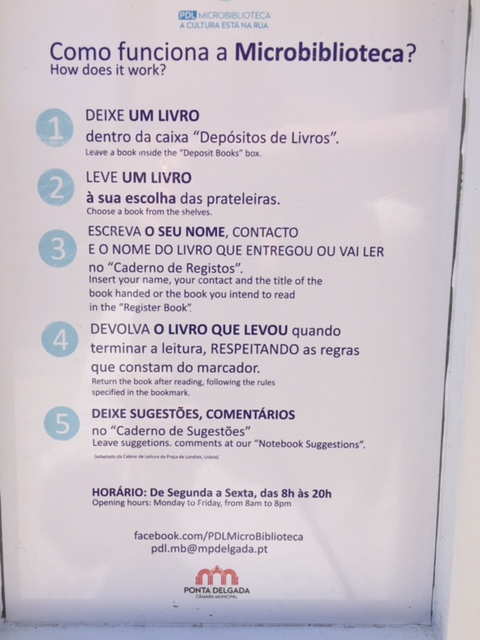
What a lovely surprise to find this Micro Library in the center of Ponta Delgada on Sao Miguel Island in the Azores. You can borrow a book (you enter the information into a log book) and you can donate books too. I wish I had had a book to contribute and that I could read Portuguese.
For more information, visit their facebook page.
Labels:
Book Arts Tuesday,
Libraries
Thursday, October 17, 2013
Thoughtful Thursday-Neil Gaiman on Reading & Libraries
The Guardian has published an edited version of Neil Gaiman's lecture for the Reading Agency which was delivered on Monday October 14 at the Barbican in London. The Reading Agency is a charity whose mission is to give everyone an equal chance in life by helping people become confident and enthusiastic readers. He makes a passionate argument for reading and libraries. It's well worth reading. Here's a taste:
Fiction has two uses. Firstly, it's a gateway drug to reading. The drive to know what happens next, to want to turn the page, the need to keep going, even if it's hard, because someone's in trouble and you have to know how it's all going to end … that's a very real drive. And it forces you to learn new words, to think new thoughts, to keep going. To discover that reading per se is pleasurable. Once you learn that, you're on the road to reading everything. And reading is key. There were noises made briefly, a few years ago, about the idea that we were living in a post-literate world, in which the ability to make sense out of written words was somehow redundant, but those days are gone: words are more important than they ever were: we navigate the world with words, and as the world slips onto the web, we need to follow, to communicate and to comprehend what we are reading. People who cannot understand each other cannot exchange ideas, cannot communicate, and translation programs only go so far....
I do not believe that all books will or should migrate onto screens: as Douglas Adams once pointed out to me, more than 20 years before the Kindle turned up, a physical book is like a shark. Sharks are old: there were sharks in the ocean before the dinosaurs. And the reason there are still sharks around is that sharks are better at being sharks than anything else is. Physical books are tough, hard to destroy, bath-resistant, solar-operated, feel good in your hand: they are good at being books, and there will always be a place for them. They belong in libraries, just as libraries have already become places you can go to get access to ebooks, and audiobooks and DVDs and web content. ...
Libraries really are the gates to the future. So it is unfortunate that, round the world, we observe local authorities seizing the opportunity to close libraries as an easy way to save money, without realising that they are stealing from the future to pay for today. They are closing the gates that should be open.
The lecture in the Guardian
Neil Gaiman's website
Thanks to Janice Comer for the alert on Facebook. Photo is by Robin Mayes.
Fiction has two uses. Firstly, it's a gateway drug to reading. The drive to know what happens next, to want to turn the page, the need to keep going, even if it's hard, because someone's in trouble and you have to know how it's all going to end … that's a very real drive. And it forces you to learn new words, to think new thoughts, to keep going. To discover that reading per se is pleasurable. Once you learn that, you're on the road to reading everything. And reading is key. There were noises made briefly, a few years ago, about the idea that we were living in a post-literate world, in which the ability to make sense out of written words was somehow redundant, but those days are gone: words are more important than they ever were: we navigate the world with words, and as the world slips onto the web, we need to follow, to communicate and to comprehend what we are reading. People who cannot understand each other cannot exchange ideas, cannot communicate, and translation programs only go so far....
I do not believe that all books will or should migrate onto screens: as Douglas Adams once pointed out to me, more than 20 years before the Kindle turned up, a physical book is like a shark. Sharks are old: there were sharks in the ocean before the dinosaurs. And the reason there are still sharks around is that sharks are better at being sharks than anything else is. Physical books are tough, hard to destroy, bath-resistant, solar-operated, feel good in your hand: they are good at being books, and there will always be a place for them. They belong in libraries, just as libraries have already become places you can go to get access to ebooks, and audiobooks and DVDs and web content. ...
Libraries really are the gates to the future. So it is unfortunate that, round the world, we observe local authorities seizing the opportunity to close libraries as an easy way to save money, without realising that they are stealing from the future to pay for today. They are closing the gates that should be open.
The lecture in the Guardian
Neil Gaiman's website
Thanks to Janice Comer for the alert on Facebook. Photo is by Robin Mayes.
Labels:
Libraries,
Literacy,
Thoughtful Thursday
Friday, October 14, 2011
Little Free Library
Thanks to Stephanie Sherwood's post on the Book Arts List, I learned about this wonderful project of Rick Brooks and Todd Bol who are the cofounders of the nonprofit Little Free Library. Here's an excerpt from the article in the Library Journal that describes how their project got started:
In 2009, they began fabricating and installing little libraries around Madison, WI. The libraries are essentially a nicely designed, weatherproof hutch mounted on poles, which contain a collection of about 20 books and a sign that reads "Take a Book, Leave a Book."
Literacy and a sense of community are the project's bedrock, and it has begun to take hold beyond Wisconsin.
"The primary motivation, without any doubt, is the good feeling that people get around these," said Brooks, who lives in Madison. "What made it happen was Tod had just built a little box in the shape of a schoolhouse as a memorial library to honor his mother. People would drive by his house and stop and say, 'What a cute idea,' " Brooks said.
About a week after finishing the first structure, Bol had a garage sale that wasn't very successful, but everyone was drawn to the little library. "I called up Rick and said, "People really want this,' " Bol said.
"It was really interesting that it was a cross section of the populace," Bol said. "It was like a literary water cooler, where people gathered and had a discussion about books in a way they wouldn't have had if they had just met on the street," he said.
I absolutely love this idea. For more information, visit the Little Free Library website.
And if you like the idea of little libraries, check out this past post about Lighthouse Libraries.
In 2009, they began fabricating and installing little libraries around Madison, WI. The libraries are essentially a nicely designed, weatherproof hutch mounted on poles, which contain a collection of about 20 books and a sign that reads "Take a Book, Leave a Book."
Literacy and a sense of community are the project's bedrock, and it has begun to take hold beyond Wisconsin.
"The primary motivation, without any doubt, is the good feeling that people get around these," said Brooks, who lives in Madison. "What made it happen was Tod had just built a little box in the shape of a schoolhouse as a memorial library to honor his mother. People would drive by his house and stop and say, 'What a cute idea,' " Brooks said.
About a week after finishing the first structure, Bol had a garage sale that wasn't very successful, but everyone was drawn to the little library. "I called up Rick and said, "People really want this,' " Bol said.
"It was really interesting that it was a cross section of the populace," Bol said. "It was like a literary water cooler, where people gathered and had a discussion about books in a way they wouldn't have had if they had just met on the street," he said.
I absolutely love this idea. For more information, visit the Little Free Library website.
And if you like the idea of little libraries, check out this past post about Lighthouse Libraries.
Subscribe to:
Posts (Atom)