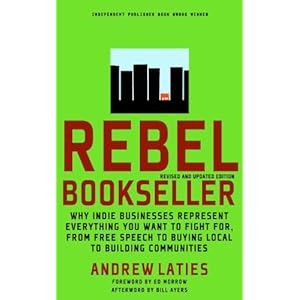
I met Andrew Laties several years ago at a meeting of the Independent Publishers of New England. We found that we had a common interest in book arts (unusual among publishers who are book lovers but not necessarily knowledgeable about artists' books) and had a great conversation. I intended to buy a copy of his Rebel Bookseller but didn't do it immediately and then it faded from my mind. Last week's Boston Sunday Globe had an interview with him in connection with a new edition of the book. This time I went straight to my local independent bookstore—the appropriate place to buy a book with the subtitle Why Indie Bookstores Represent Everything You Want to Fight for from Free Speech to Buying Local to Building Communities—and ordered a copy.
I have read Rebel Bookseller twice in three days. Andrew Laties has had a long career in bookselling, starting out working for B. Dalton in Chicago and going on to cofound the Children's Bookstore, the Children's Bookfair Company, The Children's Museum Store, PovertyFighters, the Eric Carle Museum Bookshop, and Vox Pop.
In Rebel Bookseller, his personal story is interspersed with Rants—ten of them—where he shares his opinions and observations of the bookselling and publishing worlds and his Rough Rules of Rebel Bookselling. He is an optimist and believes that now is a great time to open an independent bookstore. His rallying cry is loud and clear but in telling his story, we see that the road is not easy. It's long hours, hard work, and most importantly—constant adaptation and change.
If you are interested in the world of bookstores and publishing, the tactics and effect of the chains and amazon on independent bookstores, this is the book for you. If you are thinking of opening a bookstore, this is a must-read. Andrew Laties believes in the things he lists in his subtitle—free speech, buying local, and building communities. He is passionate and inspirational and realistic.
May I suggest you do what I do—check out the Rebel Bookseller on amazon if you want more information—and then go order it from your local independent bookstore.
The top image is my bookmark for Rebel Bookseller. Take a look at my youtube tutorial to learn how to make your own Bookmark Book.
Showing posts with label Bookmarks. Show all posts
Monday, August 01, 2011
Saturday, April 30, 2011
National Poetry Month/Sharing the Seasons
Here's a wonderful book of poetry about the seasons edited by Lee Bennett Hopkins and illustrated by David Diaz. I was browsing the poetry section in the children's room of the library and this book was on display on top of the shelves. The cover was like a magnet and I took the book home. There are twelve poems for each season and the illustrations are vibrant celebrations. A great way to mark the movement of the year.
Labels:
Bookmarks,
Poetry,
Seasonal Celebrations
Thursday, April 28, 2011
National Poetry Month/Langston Hughes
I used a green pentel brush marker to write out the beginning of Langston Hughes' poem, "In Time of Silver Rain" because Alice Walker talks about the encouraging notes Langston Hughes wrote her in green ink.
Here are three excellent picture books by or about Langston Hughes.
Alice Walker's biography of Langston Hughes for children has extra meaning because she knew him and he was encouraging to her as a young writer. His life story is beautifully told through text and illustrations.
The next two are picture books of poems. Each is an example of the highest order of illustrations in its media—watercolor and photography.
Charles R. Smith Jr. has created such a complete experience with a short poem (33 words), elegant type, and eloquent photographs. I appreciate it for the poem and for the beauty of the book design—a perfect merging of type and illustration that enhances the meaning of the words.
E. B. Lewis's The watercolors are so fluid, so rich, and so deep. To me this book feels like a poem set to music.
Hear Langston Hughes reading A Negro Speaks of Rivers.
Watch a video of images set to Langston Hughes reading April Rain from Classical Baby. Both readings are from the Poetry Foundation.
Here are three excellent picture books by or about Langston Hughes.
Alice Walker's biography of Langston Hughes for children has extra meaning because she knew him and he was encouraging to her as a young writer. His life story is beautifully told through text and illustrations.
The next two are picture books of poems. Each is an example of the highest order of illustrations in its media—watercolor and photography.
Charles R. Smith Jr. has created such a complete experience with a short poem (33 words), elegant type, and eloquent photographs. I appreciate it for the poem and for the beauty of the book design—a perfect merging of type and illustration that enhances the meaning of the words.
E. B. Lewis's The watercolors are so fluid, so rich, and so deep. To me this book feels like a poem set to music.
Hear Langston Hughes reading A Negro Speaks of Rivers.
Watch a video of images set to Langston Hughes reading April Rain from Classical Baby. Both readings are from the Poetry Foundation.
Tuesday, April 19, 2011
National Poetry Month/The Haiku Apprentice
I just read this wonderful book, The Haiku Apprentice: Memoirs of Writing Poetry in Japan by Abigail Friedman for the second time and I remember why I loved it so much the first time. Abigail is a US diplomat. When she was in Japan, she took up writing poetry after a chance encounter with Traveling Man Tree (his haiku name) and joined a haiku group.
When they first met, Traveling Man Tree described why writing haiku is different from golf. Golf is his hobby, but he does haiku.
Haiku is different. For me, haiku is a question of feeling, of sensibility. I can't just work sixteen-hour days and then say to myself, "Okay, if I concentrate hard, if I work at finding just the right word, I will compose a good haiku." I need to change how I approach the world. I need to look at the flowers and the grass beside the road. I've got to try to write poetry about what I see around me. I believe that the more I approach haiku in this way and the more I understand the essence of haiku, the better my poetry will be.
The spirit of haiku described here is inspiring whether you are or want to be a writer of haiku or not. The people she meets are full of wisdom and humility and I loved being in their presence. I found much to guide me in my work as an artist. The haiku group offered a respectful environment for learning and sharing and as a teacher I found lessons there as well.
At Abigail's first haiku group meeting, the haiku master Kurado Momoko said:
My job is not to judge whether you have written well or poorly, but to help you write a haiku that is true to yourself.
We can each write haiku because we each have a soul. Every soul is equal in a haiku group, and there is room in a haiku group for every soul.
A conversation with Abigail Friedman in Water Bridge Review
When they first met, Traveling Man Tree described why writing haiku is different from golf. Golf is his hobby, but he does haiku.
Haiku is different. For me, haiku is a question of feeling, of sensibility. I can't just work sixteen-hour days and then say to myself, "Okay, if I concentrate hard, if I work at finding just the right word, I will compose a good haiku." I need to change how I approach the world. I need to look at the flowers and the grass beside the road. I've got to try to write poetry about what I see around me. I believe that the more I approach haiku in this way and the more I understand the essence of haiku, the better my poetry will be.
The spirit of haiku described here is inspiring whether you are or want to be a writer of haiku or not. The people she meets are full of wisdom and humility and I loved being in their presence. I found much to guide me in my work as an artist. The haiku group offered a respectful environment for learning and sharing and as a teacher I found lessons there as well.
At Abigail's first haiku group meeting, the haiku master Kurado Momoko said:
My job is not to judge whether you have written well or poorly, but to help you write a haiku that is true to yourself.
We can each write haiku because we each have a soul. Every soul is equal in a haiku group, and there is room in a haiku group for every soul.
A conversation with Abigail Friedman in Water Bridge Review
Saturday, April 16, 2011
National Poetry Month/William Carlos Williams
Here's a wonderful biography of William Carlos Williams for children. It focuses on his love of poetry and his decision to make a life of being both a poet and a doctor. Many of Williams' poems are integrated into the book.
The evocative illustrations by Melissa Sweet are a combination of watercolor, collage, and mixed media. She gives us a welcome window on her creative process in the Illustrator's Note.
The artwork for every book calls for a different interpretation. These pictures needed to convey his era and the modern art of his time that was so influential to Williams. There were a lot of false starts—nothing I did seemed powerful enough to match his poems. Then I looked to a big box of discarded books I had from a library sale. One of the books had beautiful endpapers and I did a small painting on it. Then I took a book cover, ripped it off, and painted more. The book covers became my canvas, and any ephemera I had been saving for one day became fodder for the collages.
Every project furthers an artists, but this book was a true gift.
You can view the poem The Uses of Poetry at poets.org with text flow. I love watching the words slowly appear and disappear.
The evocative illustrations by Melissa Sweet are a combination of watercolor, collage, and mixed media. She gives us a welcome window on her creative process in the Illustrator's Note.
The artwork for every book calls for a different interpretation. These pictures needed to convey his era and the modern art of his time that was so influential to Williams. There were a lot of false starts—nothing I did seemed powerful enough to match his poems. Then I looked to a big box of discarded books I had from a library sale. One of the books had beautiful endpapers and I did a small painting on it. Then I took a book cover, ripped it off, and painted more. The book covers became my canvas, and any ephemera I had been saving for one day became fodder for the collages.
Every project furthers an artists, but this book was a true gift.
You can view the poem The Uses of Poetry at poets.org with text flow. I love watching the words slowly appear and disappear.
Tuesday, March 22, 2011
Bookmark/The Kitchen Madonna
I've been a longtime fan of this book by Rumer Godden. When I first read it, it was the touching story of an odd boy who makes a kitchen Madonna for Marta who takes care of him and his sister while his busy architect parents were at work and misses her childhood home in the Polish Ukraine. It is a wonderfully unsentimental story of love, but also one of creative problem solving and using recycled materials. It's a great companion to the Flowers from the Collage Box project.
Labels:
Bookmarks,
Recycling and Creativity
Friday, March 18, 2011
Bookmark/Traditional Crafts of Ireland
Yesterday Sandy Riddell Wagner posted a link to an Irish Traditional Crafts website. It features films by David and Sally Shaw-Smith and mentioned that they also had a book with Thames and Hudson. With a little bit of the luck of the Irish, the book was on the shelf of my local library. I brought it home and spent a few hours learning about traditional ways of textiles, stonework, woodwork, willow, rush and straw work (my favorite), leather (including bookbinding), metalwork, ceramics, glassware, calligraphy (Denis Brown), and rural life. It's beautifully photographed by the Shaw-Smiths with writing by a variety of different people. A treat for St. patrick's Day. I may need to add it to my library.
Labels:
Bookmarks,
Books to Read
Subscribe to:
Posts (Atom)


