Showing posts with label Translations. Show all posts

Monday, June 04, 2007

Translations Farewell

Tomorrow we take down the exhibit at Sasaki Associates. While I did not see it often, I always find it sad to take down an installation, especially something that seemed to fit the space so well. The good news is that I now have some wonderful photos take by Tom Robinson-Cox.


Monday, May 07, 2007

Translations Trials


There seems to be a convergence of Translations installations and extreme weather.The first last June was challenged by a week of newsworthy rain. The current installation at Sasaki Associates experienced the effects of a newsworthy
northeaster. When I woke one morning at 4 o'clock to the sound of whipping wind and pelting rain, my first thought was of the trees at Sasaki. Later that morning the email came.

We left shortly after for a trip to Korea (more about that later) and finally got to Sasaki on April 27th to assess the damage and make repairs. My husband Charlie was all for leaving it as is and accepting its current state as the work of nature. I didn't mind it showing the effects of nature but had gentle erosion rather than brutal destruction in mind. I also felt that the destruction was the result of a design flaw on my part not just nature's work. The paper and ink were fine. The problems occurred where the cord that attached the banners to the trees ran through.


We decided to repair some but not all. One of the trees had partially fallen banners that hung down beautifully and I rather liked the sound of the paper rustling in the breeze. We left them as they were. On another tree, the fallen pieces were a twisted mess. These we repaired as we did those on several other trees. Some of the banner pieces had completely fallen off and many of those we brought home. I was pleased with the end result and hope our current mild weather continues until the exhibit ends on June 4.

I am going to continue to experiment. My new plan is to sew the paper to cloth and run the cord through the cloth rather than the paper. I'm going to make a sample and test it on a tree over the summer. I feel fortunate that one of the characteristics I bring to my work is a willingness to keep working at a problem until I solve it. I think it brings up the merit of taking pleasure in the process. If there is enjoyment in the making, it is easy to keep repeating it until works.

Thursday, March 29, 2007

Translations Installation

My husband Charlie and I spent two days at Sasaki installing the work. On Day 1, we installed all the squares. We had to drill and place 105 screws. The squares are arranged in sets of five in a variety of configurations.

Charlie had a brilliant idea to make a guide out of angle iron which friend Ed Eaton fabricated. The guide has five holes drilled in it the correct distance apart. After finding the center of the wall, we were able to screw in the guide, level it, and correctly drill the rest of the holes in the row.

It was still a lot of work but without this tool it would have much more diffcult and not as even and straight. I worked hard to be a good helper and we were tired but still cheerful at the end of the day. I could never even dream of projects like this if I didn't know I had Charlie to figure out all the details.


On Day 2, we installed the banners on the trees. This went much more quickly. The indoor and the outdoor make a good combination.

Friday, March 23, 2007

Translations at Sasaki Associates


Translations, a two-part exhibition at
Sasaki Associates
64 Pleasant Street
Watertown, MA
March 29-June 4
Reception: Thursday, March 29 from 5-7 pm
Hours: Monday-Friday, 8:30 AM to 5:00 PM

The announcement was designed by Neda Movaghar, a graphic designer at Sasaki. The card itself is large (11" wide by 6" high) and impressive. It is always fascinating to see what fresh eyes will bring to a project. The image is from a scan I made of one of the squares. Having worked with and thought about the squares for so long, it was a surprise and a treat to see her rectangular design without a square in site. I love it.

Monday, March 19, 2007

Translations in Progress


Translations opens at Sasaki Associates in Watertown, MA on March 29. My husband and I will be installing it on the 26th. The 105 squares are almost finished. I purchased 8" wooden square panels for painting at Artist and Craftsman Supply in Boston. After a coat of polyurethane, they are covered with a red Lokta paper from Nepal that I purchased at Rugg Road in Boston. It's a relaxing but time-consuming project in which I have been ably assisted by Kate Getz, a Newburyport High School Junior.


Part II of the exhibition will be Translations III: Spring Awakening, an installation on the river birch trees in the courtyard. Banners of handmade paper from Bhutan with ink drawings of natural materials will be hung on all the trees. To the Druids, the birch is a symbol of new beginnings and awakening. After the weather-related trials of the first Translations installation at Maudslay, I have taken to making the banners two layers thick with the cord inside flexible plastic tubing which is inserted into channels that have been sewn in the paper. I was overwhelmed at the thought of sewing 41 banners that were 4" wide and 84" long. My friend Chris Bobek saved the day when she brought her sewing machine to my studio and the two of us spent a day stitching away. This week I will be going to Watertown to gather natural materials for the drawings.

Tuesday, January 30, 2007

Transformed Translations


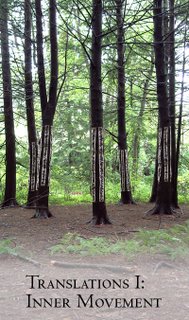
Transformed Translations is a work in progress that grew out of an outdoor piece called Translations I: Inner Movement created for an outdoor sculpture exhibition at Maudslay State Park in Newburyport, MA in June 2006. The work was a celebration of the inner life of the trees and the powerful spirit of nature. Banners from handmade paper from Bhutan with ink drawings made using gathered natural materials as brushes surrounded five trees in a grove of hemlocks. A series of 105 eight-inch wooden squares will be arranged multiples of five. The number five makes reference to the five elements in Japanese and Chinese philosophy: Earth, Water, Fire, Wind, and Ku which means Void or Sky and is sometimes translated as Heaven as well as the five trees at Maudslay.

Transformed Translations, along with a new Translations installation on the trees in the courtyard, will be on exhibit at Sasaki Associates in Watertown, MA from March 29 to June 4 with an opening reception on March 29 from 5-7 pm.

Sunday, January 21, 2007

Translations II: Living Sanctuary


Translations II: Living Sanctuary, a collaborative installation with art students from Walpole High School, was installed at Moose Hill Audubon Sanctuary in Sharon, MA in September 2006.

Over the summer I had read a review of the Burning Man arts festival by Anthony Haden-Guest in Art in America in which he contrasted its "therapeutic culture of creativity" with the Darwinist art world. Thinking about Burning Man's open and participatory nature led me to wonder if it was necessary for me to do the drawings for another Translations installation or whether I could offer the "therapeutic culture of creativity" to others.

The opportunity came when I received notice of a call for entries for an exhibition entitled "Trees: Unfolding Visions" at the Moose Hill. I boldly called and described my project. Not only was the coordinator Jan Goba interested, she knew of an art teacher in neighboring Walpole who liked doing extracurricular projects with her students. I went for a preliminary visit to meet Jan and choose a space. I was looking for hemlock trees and was thrilled to find a grouping along a stone wall and directly in front of the Visitor's Center. It all came together quickly, so quickly that I wasn't able to have the students help me with the entire project. I did all the grunt work of constructing the banners and because of my schedule it involved one long and painful day on the sewing machine (an advancement over the original Maudslay piece which was all stitched by hand). The kids did the drawings and helped with the installation. My concern was whether they would understand my intention–to make drawings that take their inspiration from the inner spirit of the trees and are about feelings rather than images or symbols. I was very pleased with the results and they seemed to get something out of the process. I hope to be able to do more installations with enough time to involve participants in the entire process.


top photo by Fred Martins
Bottom photo: Students finishing up the installation with Patrick Ryan filming for Sharon Cable TV on the left

Translations I Part 2


With the month of January 2007 in its second half and my New Year's resolution of keeping up with this blog well on its way to being unfulfilled, it seemed like the time was at hand to do a posting. My 21-year-old son has been encouraging me to blog and had suggestions about ways to get going. However, being a former English major who is slowly adapting to the multi-tasking hyper-linked world of the computer generation and who still has a deep fondness for stories with a beginning, middle, and end, I could not go on to posting new things until I finished out the story I started with my June post about Translations I at Maudslay State Park.

My last post on June 6 did not mention that the reception was postponed due to rain. And it continued to rain for the entire next week. I didn't mind the idea of the banners weathering through the course of the show (one month) but didn't want them in tatters for the walk-through and reception. I fretted all week but stopped making daily trips to Maudslay after the third day. After having been making art for over 25 years I now find myself in the place where there are, in certain settings, a fair number of people who know my work. This is wonderfully gratifying but when I envisioned my paper banners in dripping piles at the bottom of the trees, it made me even more nervous. Plus there were people who looked at me like I was crazy when I described the project- who makes an outdoor sculpture with paper? The paper from Bhutan is made from the long fibers of Daphne plants and I knew it would be strong. Plus I had made my tests.


I nervously arrived at the park the day before the reception and found damage that was reparable. All in all, the paper held up pretty well. The places it tore were where the paper was not sewn together with as much overlap or where the banners shifted on the trees and the weight of the wet paper caused the problems. Where the banners were taut against the tree, all was well. With difficulty I sewed together the sopping wet pieces. The day of the reception the sun was shining and the paper was dry and more or less intact.


At the end of June, we took down the banners (wet yet again). I felt a mixture of sadness (I really loved the feeling of standing among the trees with the flowing ink banners) and relief (no more visions of shredded paper popping unbidden into my head). I brought the banners back to the studio and stretched them out to dry. I then rolled the banners, put them in a basket, and waited to see what their next incarnation would turn out to be.

Tuesday, June 06, 2006

Translations I: Inner Movement


Outdoor Sculpture at Maudslay

For years I have been wanting to participate in the annual outdoor sculpture exhibit at Maudslay State Park here in Newburyport, MA. This is a community art celebration, with work by artists of all ages and levels of experience. With the Spirit Book Series finished and my work feeling like it is transition, this year seemed to be the perfect year to try. Translations I: Inner Movement is the result.

This past winter/early spring, I took a class in Chinese brush painting at the Newburyport Art Association with Bruce Iverson. I didn't make it to all the classes but learned several things. One is that I probably don't want to do Chinese brush painting or calligraphy at this point in my life. Although I spent years totally absorbed in the study of Western calligraphy and loved the hours I spent at my drawing board trying to both perfect letterform and write with a lightness of touch, I am in a different place now. I have had a taste of making work that comes more completely from inside of me. However, I did reconnect with my love of ink and paper. The feeling of both excitement and contentment that comes from bringing brush to paper was deeply felt in the classes and I wanted to continue that relationship.

In my calligraphy days, I put letters on everything- tshirts, pottery dishes made by my friend Sandra, kitchen tiles- as well as envelopes, cards, and fine art pieces. As I walked through Maudslay thinking about the sculpture show, I got that same itch to bring my rediscovered love of ink and paper into the world around me. I've always been fascinated by the Japanese custom of wrapping rope, shimenawa, around trees and went back and looked through my collection of books about Japan, Japanese culture and Japanese art. I originally started with the idea that I would make banners that hung from trees but could not figure out the logistics.

I decided to tie long strips of paper with ink drawings to the trees. I did my first tests on a tree outside our fence and along the street. I tested one of my favorite papers from Bhutan and it made it through several rains without a problem. The paper is made from the long fibers of the Daphne plant and is quite strong. The sumi ink from Japan is waterproof. I used to use it for calligraphic signs and a store had one in their window for years with no fading. Because I wanted the work to be as much about nature as possible, I decided to use pieces of fallen sprays of hemlock leaves and cones gathered from under the trees instead of a brush.

Here's what I wrote in the proposal: "Standing among the tall trees, I feel their spirit. I gather sprays of needles and cones and bring them into my studio. Dipping the sprays in ink, I make marks on paper. The papers are sewn onto cord and brought back to Maudslay where they are tied around trees. The movement of the ink brings to the outside the trees' inner life. At the close of the exhibition, the papers will become books celebrating the installation."

The work was installed on Sunday June 5. I hope it will be the beginning of a new series. The exhibition continues through June 25 with a Reception and Tour on Saturday, June 10 from 3-6 PM. Park hours are 8:30 am to sunset.
Related Posts Plugin for WordPress, Blogger...

ShareThis